What happened in the PRX vs G2 VALORANT Champions Shanghai group stage match and why does it matter?
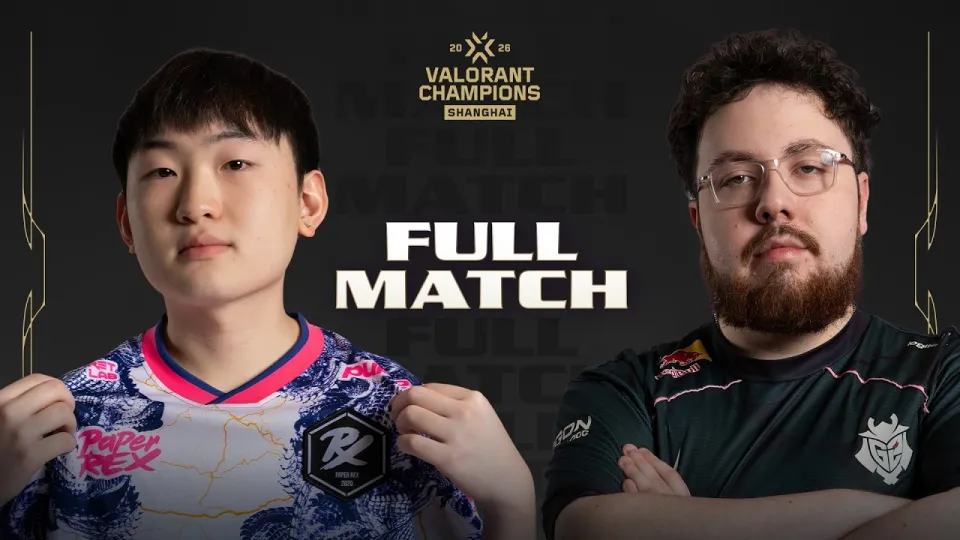
Video: PRX vs. G2 — FULL MATCH — VALORANT Champions Shanghai — Group Stage
Want articles like this for your own video to promote it on YouTube and Google? Order them through the Telegram bot @sat_sit_bot. The bot writes and publishes the articles itself (with your YouTube video embedded) on popular topical websites (no ads). Free trial — 50 articles.
· based on the channel VALORANT Champions Tour
Key takeaways
- PRX faced G2 in the VALORANT Champions Shanghai group stage, with the full match broadcast by the VALORANT Champions Tour channel.
- Shanghai 2026 ran from September 24 to October 18, featuring 16 teams from Americas, CN, EMEA and Pacific.
- The series went the distance, with the third map becoming the decisive battleground.
- Viewer discussion centered on d4v41's Haven impact, Trent's Split form, and a costly Odin buy late in the match.
- VCT 2026 partners include AWS, Coinbase, EWC, ENC, Globant, HyperX, Mastercard, OnePlus, Red Bull, Secretlab and Verizon.
PRX vs G2 at VALORANT Champions Shanghai was a full-length group stage series that went the distance, and the third map became the decider. It mattered because group stage results in Shanghai directly shape playoff seeding for the 16-team field, and because PRX vs G2 has become one of the most reliably entertaining cross-region matchups in VALORANT. The full match is available on the VALORANT Champions Tour channel, and you can follow official updates and announcements via the official VALORANT Esports Twitter/X account.
What made PRX vs G2 a must-watch VALORANT series at Shanghai
PRX vs G2 carries a specific kind of weight in VCT: it is a Pacific-versus-Americas collision that consistently produces close, high-tempo maps. In Shanghai, that pattern held. The series was not a clean sweep in either direction; the maps traded momentum, and the broadcast's full-match format gave viewers the complete arc rather than a highlight reel.
A few structural facts frame the match:
- Shanghai hosted 16 teams from four regions: Americas, CN, EMEA and Pacific.
- The event window ran from September 24 to October 18, with the group stage as the first filter before playoffs.
- Every group stage win matters for bracket position, which raises the stakes on individual maps, not just series results.
- The full match was published by the VALORANT Champions Tour, the official broadcast channel for VCT events.
For PRX, the match was another test of their aggressive, tempo-driven style. For G2, it was a chance to impose structured defaults and punish overextension. That stylistic contrast is what makes the matchup a recurring fixture in VCT discussion.
How the maps played out and where the series turned
The series followed a familiar PRX-versus-G2 rhythm: one side wins a map on the back of individual heroics, the other answers with cleaner team play, and the decider becomes a test of composure. Haven stood out as a map where d4v41's impact was repeatedly highlighted by viewers, while Split drew attention to Trent's form as a near-complete player in that map's meta.
The third map was the pivot. In a best-of series, the decider compresses everything: pistol rounds, economy management, and the ability to reset after a lost bonus. Viewer reactions to the third map focused on Invy's uptick in form and on a late sequence that many described as a turning point. A single failed retake or a mistimed ultimate in that environment can decide the series.
One recurring talking point was the Odin. A heavy-machine-gun buy in a high-pressure round is a polarizing choice in VALORANT: it can shred through smokes and force opponents into uncomfortable close-quarters fights, but it also commits significant economy and can be punished by disciplined spacing. In this match, the Odin buy became a meme and a genuine tactical question at the same time.
What the viewer reaction says about the match
The audience response to the full match broadcast was overwhelmingly positive, with the most-liked comment being the standard spoiler shield that VCT viewers use to protect others from results. That detail alone says something about how the community consumes these broadcasts: many people watch the full match on demand, sometimes hours or days later, and the comment section is structured around that behavior.
Several themes dominated the discussion:
- Consistency of the rivalry: viewers described PRX vs G2 as reliably entertaining, which is why the fixture keeps drawing attention regardless of group stage stakes.
- Individual performances: d4v41 on Haven, Trent on Split, and Invy on the third map were singled out as difference-makers.
- Critical moments: a late-round sequence drew a wave of reactions, with fans of both teams acknowledging how close the series was.
- Production quirks: viewers noticed small details in the broadcast, from on-screen graphics to a brief audio question, which is typical for long-form full-match uploads.
- Emotional investment: PRX fans in particular described the experience as stressful, which tracks with a series that stayed competitive into the final map.
This is the value of the full-match format: it preserves the tension that highlight clips flatten. A 2-0 sweep and a 2-1 grind can look similar in a recap, but they feel completely different when you watch the economy swings in real time.
Why the group stage format changes how teams approach Shanghai
Group stage VALORANT at an international event is a different game from playoffs. With 16 teams and a limited number of matches, teams cannot afford to treat early rounds as warm-ups. Seeding determines bracket paths, and bracket paths determine how quickly a team runs into the tournament favorites.
That pressure shows up in draft and preparation:
- Map bans and picks become more conservative, because a comfort-map loss can cascade into a must-win decider.
- Teams lean on set plays and rehearsed executes rather than improvisation, especially on defense-heavy maps.
- Individual form matters more, because there is less time to fix systemic issues between matches.
- Economy discipline becomes a deciding factor, since group stage matches often hinge on two or three bonus rounds.
For PRX and G2 specifically, the match served as a measuring stick. PRX's ceiling is tied to their willingness to take fights others avoid; G2's ceiling is tied to their ability to convert structure into round wins. When those two approaches meet, the result is usually a series that stays close and a viewer base that stays engaged.
Common questions from the PRX vs G2 broadcast
Long broadcasts generate their own meta-conversation, and this one was no exception. Viewers asked about everything from map-specific performances to production details. The most common threads were about which player carried which map, whether a particular buy was a mistake or a calculated gamble, and how the result affects each team's path through the group stage.
There were also questions about the broadcast itself: whether a moment of audio was cut, why certain teams appeared on screens during the arena shots, and how the full-match upload compares to the live stream. These are normal for VCT events, which combine a live arena audience with a global streaming audience and then publish the full match on demand.
If you are catching up on Shanghai, the practical approach is to watch the maps in order and avoid the comment section until you finish. The spoiler shield exists for a reason, and the match is more enjoyable when the decider is genuinely undecided.
Useful links
- Official VALORANT Esports on Twitter/X: https://twitter.com/ValorantEsports
- Official VALORANT Esports on Facebook: https://www.facebook.com/ValorantEsports/
- Official VALORANT Esports on Instagram: https://www.instagram.com/VALORANTESPORTS/
- Official VALORANT Esports on TikTok: https://www.tiktok.com/@valorantesports
- Official VALORANT on Twitch: https://www.twitch.tv/valorant
Final thoughts on PRX vs G2 at VALORANT Champions Shanghai
PRX vs G2 delivered exactly what the matchup promises: a full-length series that stayed competitive into the third map and produced individual performances worth rewatching. The result matters for group stage seeding, but the bigger takeaway is stylistic. PRX's aggression and G2's structure remain two of the most interesting opposing philosophies in VALORANT, and Shanghai gave them another stage to test each other. If you want the complete picture rather than a highlight reel, watch the full match as published by the VALORANT Champions Tour, the channel behind this broadcast. For schedules, announcements and official updates, follow the VALORANT Esports Twitter/X account.
Source: PRX vs. G2 — FULL MATCH — VALORANT Champions Shanghai — Group Stage · Markdown version
Questions & answers
Did PRX vs G2 at VALORANT Champions Shanghai go to a third map?
Yes. The series went the distance, and the third map became the decisive one. Viewer discussion focused heavily on that map, particularly on individual form swings and a late sequence that many described as the turning point of the series.
Which players stood out in the PRX vs G2 match?
Viewers repeatedly highlighted d4v41's impact on Haven and Trent's form on Split, where he looked like a complete player for the map's meta. Invy was also singled out for an uptick in performance on the third map, which helped decide the series.
Why was the Odin buy such a talking point in this match?
The Odin is a polarizing weapon in VALORANT. It can shred through smokes and force close-range fights, but it commits significant economy and can be punished by disciplined spacing. In a tight group stage series, that trade-off becomes a real tactical question rather than just a meme.
How does this result affect the group stage at VALORANT Champions Shanghai?
Group stage results determine playoff seeding, which shapes how quickly a team runs into tournament favorites. With 16 teams from Americas, CN, EMEA and Pacific competing, every map win matters, and a close series like this one can shift bracket paths significantly.